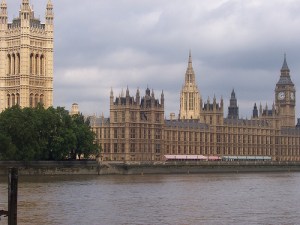
The Rump Parliament had not served the purpose that Oliver Cromwell had intended; the members were distrustful of the army and their main concern was to create legislation that would ensure the survival of the Parliament.
Cromwell lost patience after learning that Parliament was attempting to stay in session despite an agreement to dissolve. He attended a sitting of Parliament and lambasted the Rump Members. “You have sat too long for any good you have been doing lately … Depart, I say; and let us have done with you. In the name of God, go!” he declared.
Barebone’s Parliament was then established: 144 Members of Parliament who not elected, but selected by Cromwell’s officers for their religious fervour. This group still didn’t satisfy Cromwell, and on 12 December 1653, while the more pious of the Members were at a prayer meeting, a group of army supporters, led by the general John Lambert, gathered together to vote to dissolve Barebone’s Parliament. A few days later, Cromwell was installed as Lord Protector of the realm.
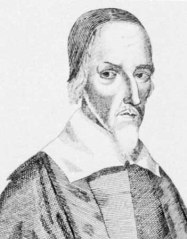
Barebone’s Parliament takes its name from a man who rejoiced in the name of Praisegod Barebone, the Parliamentary nominee for the City of London. He was a fierce anti-royalist, supporter of Cromwell, anabaptist, leather seller, politician, Freeman of the Leathersellers’ Company in 1623, and was minister for a baptist congregation.
Barebone’s fierce anti-royalist stance meant that pamphlets of strong opinion and language usually flew around from and in answer to him. He certainly incurred the disapproval of the local lads: Pepys, in his diary, makes more than one mention of the fact that “the boys had last night broke Barebone’s window”.
Barebone had two, possibly apocryphal, brothers, called Christ-came-into-the-world-to-save Barebone and If-Christ-had-not-died-thou-hadst-been-damned Barebone (abbreviated to just Damned Barebone). Presumably if these brothers did exist, they were older than Praisegod, whose parents must by then have been exhausted by the naming of children.
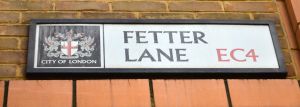 In addition to all his interests and achievements, Barebone was also once a resident of Fetter Lane, the derivation of which name is up for grabs. Take your pick from just some of the options, which include faitor, fewter, felter, faitour, and even fetter are some of the options.
The Old French word ‘faitor’ meant a lawyer, and by the 14th century the reputation of that august profession had fallen so far into disrepute that the word was synonymous with idlers. Alternatively, it appears that the lane became a spot where people in various stages of inebriation would congregate, passing on cheery greetings and advice to passersby.
As the historian John Stow puts it, the lane was “so called of Fewters (or idle people) lying there, as in a way leading to gardens, but the same is now of latter years on both sides built through with many fair houses”.
Or the name could have derived from ‘felter’ – makers of felt also carried on their business in the lane.
There is also the theory that the name could have come from the ‘faitours’ – fortune tellers who were prevalent in medieval and Elizabeth times.
As well as the idlers, the area did have workers in the form of the armorers whose workshops were located there. and the name may have come from the lance vests worn on cuirasses (also known as fetters).
In 1988 a statue of John Wilkes, a journalist and member of the notorious Hellfire Club, was erected at the location where Fetter Lane joins New Fetter Lane. In 2011 the Rolls Building, a new court of the High Court of Justice principally for commercial and property cases, was formally opened by Queen Elizabeth II.


4 responses to “Barebones Parliament, lawyers, idlers, and fetters”
[…] day in London history: on 16 December 1653, following the lack of success of the Barebones Parliament, Oliver Cromwell became the Lord Protector of England, Wales, and Scotland. The decision was made […]
[…] of these people are fascinating by virtue of their names: Sir Harbottle Grimston, for instance; and Praisegod Barebone (who was demurely named compared with his brothers). And Clotworthy Skeffington, of course, more of […]
[…] Buildings, which leads off Chancery Lane, was once a cul-de-sac. In 1877 it was extended into Fetter Lane; it may have been named after the landowner or builder. The name itself may come from the word […]
[…] prisons to fetters, or manacles for prisioners. There is a Fetter Lane and a New Fetter Lane and on the corner of these two streets is a statue of John Wilkes, a […]